Dart frogs live on the forest floor, and the forest floor is leaves. In a vivarium, a leaf layer gives frogs somewhere to hide and hunt, and it houses the springtails and isopods they eat between feedings. Most dart frog keepers treat it as part of the setup, not decoration.
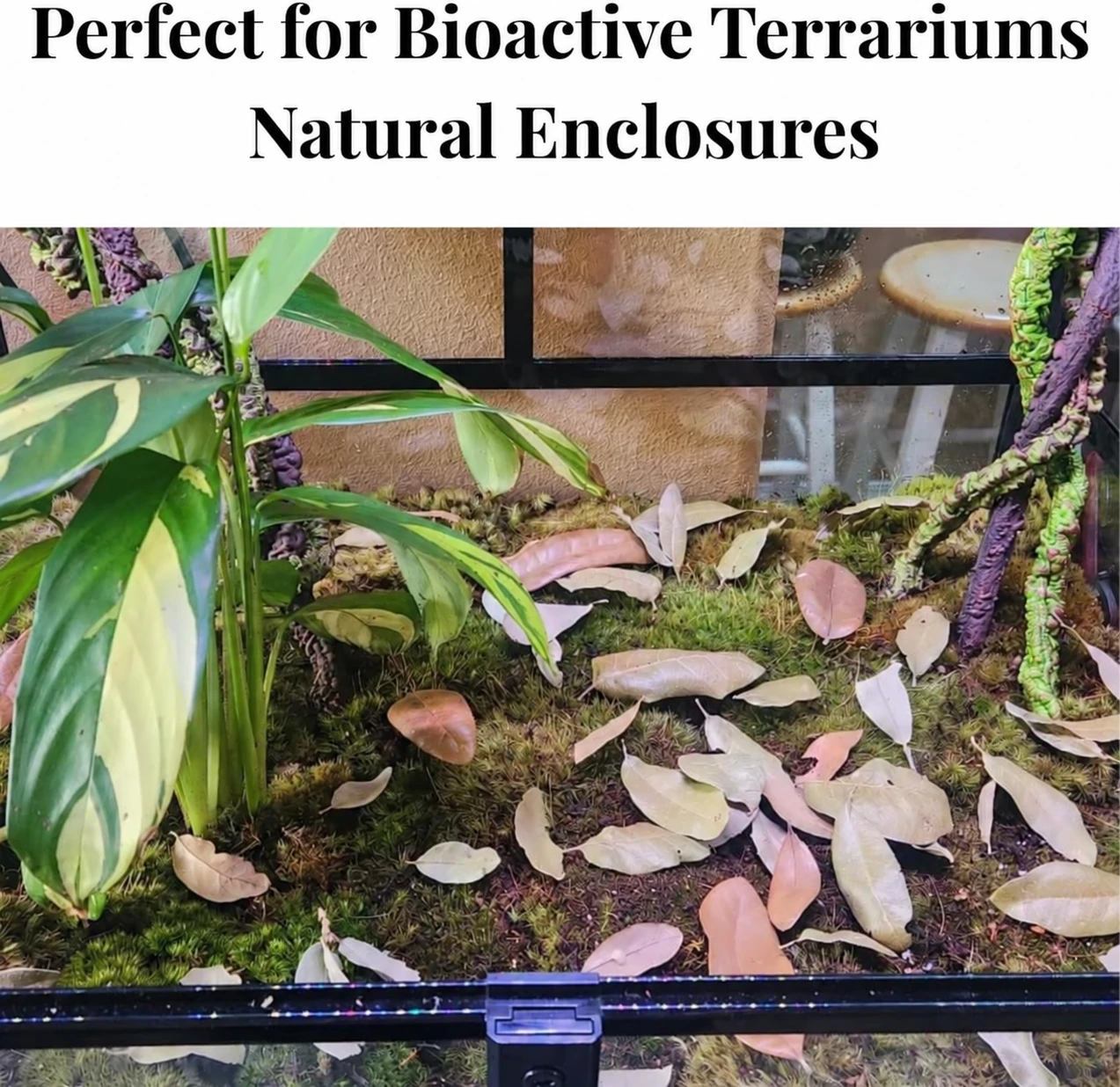
What the leaf layer does for frogs
- Cover and sight breaks. Frogs that can duck out of view tend to spend more time in the open. Leaves also break lines of sight between frogs, which helps in a group.
- A place for microfauna. Springtails and isopods live and breed in the layer and feed on the leaves as they decay. Frogs pick them off all day, and froglets depend on that kind of small prey.
- A drier surface. Leaves keep frogs off constantly wet substrate while the soil underneath stays moist for plants.
- Egg sites. Some species lay among or under leaves. Others prefer a hut or a film canister. It depends on the frog.
Which leaves hold up in a frog tank
A dart frog vivarium is warm and wet all the time, so the leaf has to tolerate that. These are the common choices:
| Leaf | Size | In a humid vivarium |
|---|---|---|
| Live oak | Small | Long-lasting. Fits small tanks and tucks around plants without smothering them. |
| Magnolia | Large | Long-lasting and leathery. Makes big hides. Can cover a lot of ground in a small tank. |
| Sea grape | Large, round | Thick and slow to decay. |
| Other oaks | Medium | Thinner than live oak and break down sooner, which feeds microfauna faster. |
Many keepers combine a small leaf with a large one: small leaves for dense cover and microfauna, a few large leaves as hides. More detail in live oak versus other leaves.
Why small leaves earn their place
Thumbnail species and froglets are tiny. A layer of small leaves gives them gaps their own size, and it gives springtails far more surface to live on than a few big leaves do. Small leaves also sit between plant stems without burying young plants, which matters in an 18-inch cube where every inch of floor is planted.
How deep
Sellers and keepers commonly recommend a layer at least a few leaves deep, roughly an inch as a minimum. Plenty of frog keepers go to two inches or more across the open floor, on the reasoning that a wild forest floor is deeper still. Leave the drain or pond edge clear, and do not bury the crowns of your plants.
For volume, one gallon of loose leaves covers about 1.6 square feet at an inch deep. An 18 × 18 inch floor at one inch takes about 1.4 gallons before you subtract wood and plants. The leaf litter sizing chart has other sizes.
Setting it up
- Finish the drainage layer, barrier, substrate, and planting first.
- Seed springtails and isopods onto the substrate.
- Scatter leaves loosely over the open floor. Do not press them down.
- Mist as usual. The layer will settle over the first week or two.
- Add frogs once the tank has had time to establish and microfauna are visible.
Preparing leaves for a frog tank
Frog keepers are more careful about hitchhikers than most, with good reason. Slugs, snails, and some predatory worms are very hard to remove from an established vivarium. Many frog keepers boil or bake every leaf that goes in, even from sellers they trust. Our leaves are sifted and winnowed but not sterilized, so for a dart frog tank we would lean toward treating them. The options are in do you need to boil or bake leaf litter?
Keeping the layer going
In a working vivarium the bottom of the layer turns into soil. Add a handful of fresh leaves on top whenever you see substrate showing through or the layer looks flat. There is no need to remove old leaves. How often you top up depends on your microfauna, misting, and temperature, so watch the tank and not the calendar.
Quick answers
Are oak leaves safe for dart frogs? Oak, live oak, and magnolia are the standard vivarium leaves and are widely used with dart frogs. Source matters: the leaves should come from ground that has not been sprayed.
Will leaves lower the humidity or cause mold? They help hold moisture at ground level. Some mold on new leaves is normal in the first weeks and usually fades as springtails establish. No leaf is mold-proof.
Do tannins matter? In a vivarium, not much. If your tank has a water feature, expect it to tint slightly.
More from the leaf ranch
- Leaf litter for isopods: choosing and using live oak
- How much leaf litter you need, by enclosure size
- Do you need to boil or bake leaf litter?
- Which leaves are safe for isopods, and which to avoid
- Live oak compared with other leaves
- What leaf litter is and how to use it in a terrarium
Give the frogs a forest floor
Pick from 1–4 gallons and buy direct or choose your marketplace.
Shop Texas live oak leaf litter →